
Social networks have gradually become embedded in our lives over the years. The first social network appeared in 1997 and was called SixDegrees. It allowed users to locate and create lists of friends, and promised to connect a person with anyone in the world in just six steps. It eventually disappeared, while others emerged and gained popularity, such as LinkedIn —focused on the professional sphere— which currently has more than 1.24 billion users.
With the arrival of Facebook on the Internet in 2004, the rules of the game changed. Until then, and during the early years of the platform created by Mark Zuckerberg, older social networks were gradually disappearing. Facebook quickly became very popular thanks to the ease and fluidity of finding contacts, creating communities, and sharing content.
Changes in Our Behavior
The use of social networks has altered our behavior in several important aspects of life:
- Our relationships with other people.
- The management (and consumption) of time.
- The interpretation of information.
- Our priorities.
- Our perception of the world.
Social networks have penetrated deeply into us and have become part of everyday normality for everyone, or almost everyone. Some people resisted them from the very beginning. Others abandoned them once they realized they brought nothing of real value to their lives.
I began using social networks on a personal level. Later, I started using them professionally, incorporating them into the online promotion strategies I designed for my clients. Over the years, these platforms have become saturated and are accelerating the growth of junk content on the Internet, the global network. They have turned into spaces for planning and executing manipulation techniques, attempting to generate trends whose effects may seem trivial in some cases, but in others directly impact particularly sensitive issues. In any case, any intention to manipulate, regardless of the subject it targets, does not serve the common good.
The freedom that social networks initially seemed to offer has turned against us. It has been transformed into slavery. We are almost forced to use them to reach others, yet trying to reach the people we actually want to reach is becoming increasingly difficult without having to give up, precisely, our freedom. We have failed to understand that we do not set the rules of the companies that own these social networks; they are the ones who have the final say over the content we display on our profiles.
Power Rules
Yes, power rules, and economic interests are what shape events around the world: wars, the destruction of ecosystems, discriminatory and violent policies, and the acquisition of media outlets to create campaigns of distraction and disinformation aimed at generating confusion among the population.
The recent case of journalist Bisan Owda, with more than 1.4 million followers on her TikTok account, illustrates the current situation of control and the authoritarian drift that is spreading across the world. Her account has been shut down due to a new aggressive and unapologetic policy that goes against everyone’s freedoms, especially those who use their profiles to expose and denounce actions carried out by the very owners of these social platforms.
I would say that, over time, we have been walking ourselves toward a virtual concentration camp with real-world consequences. There is no freedom on social networks, but there is control over the way we act and think. If you try to give a voice to the blatant injustices we are experiencing in these turbulent times, you will be erased from online social life. Soon, there will be no room left on social networks for those who wanted to use them organically to contribute even a small amount of value to society.
Shake Off the Laziness and Take Action
Technology has created a sense of comfort for us, and over time we have simplified our efforts to stay informed, in exchange for dragging our finger up and down the screen through the intoxicated feed of our accounts. For this reason, traditional journalism fights every day not to drown in the face of a gradual decline in readers, both in print and digital formats.
If we are concerned that the world is being run by a pack of unscrupulous criminals, power-hungry individuals who are destroying the world we all live in, we should take a step forward… and also a step back. Return to saving and organizing bookmarks in our browsers, reading articles from websites that can provide real value, participating in private forums managed transparently on independent platforms, subscribing to newsletters… In short, it is about making a bit of an effort to obtain information and be able to verify it, using and nurturing our own knowledge.
If we do not do this, is it because our dependence on social networks has nullified our abilities? Or is it due to apathy, because we believe we are forced to adapt to a world that makes no sense?
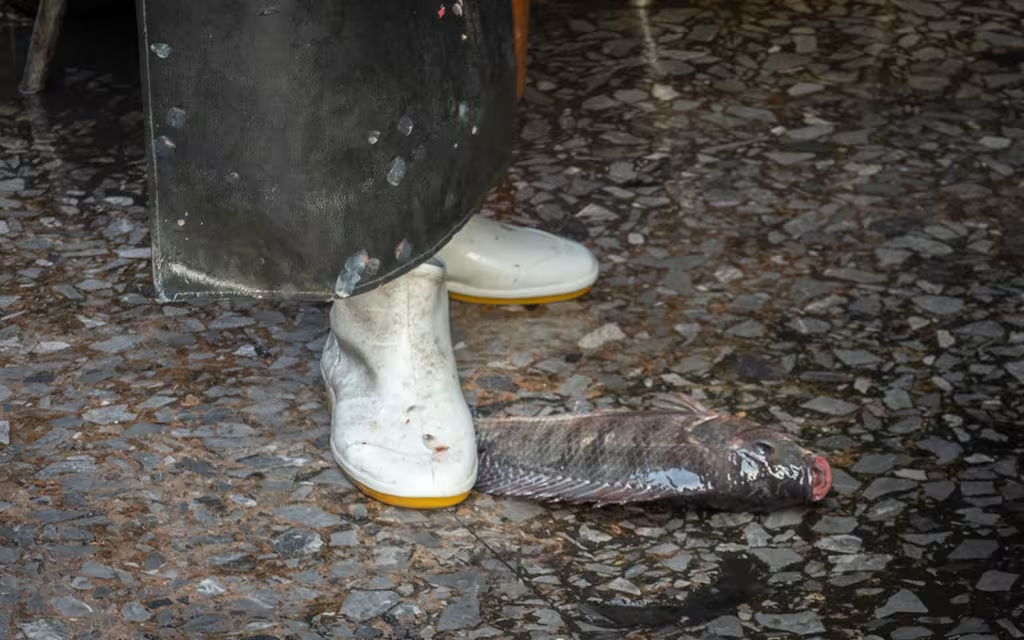
** Photograph taken in a Bangkok market.
Comments